Commercial fleet insurers have recorded underwriting losses for 13 consecutive years, with the US market alone posting a $4.9 billion deficit in 2024. Streamax has pioneered a "Trinity" paradigm—integrating AIoT sensing, AI risk control software, and 24/7 operational services—to reverse this trend. By transforming reactive claims management into a proactive risk-prevention ecosystem, we help fleets reduce accident frequency by over 30% and mitigate the catastrophic impact of "social inflation" and nuclear verdicts. Our approach focuses on converting uninsurable liabilities into predictable, data-backed assets that stabilize premiums and protect operational margins.
Persistent Losses and the Problem with Social Inflation
The commercial auto insurance sector is struggling with a widening gap between premium pricing and claim severity. While physical damage coverage remains profitable for some, auto liability loss ratios hit an 11-year high of 87.6 in 2024. This deterioration is largely driven by "social inflation," where aggressive litigation and juror emotion lead to "nuclear verdicts"—civil awards exceeding $10 million.
In 2024, the median nuclear verdict rose to $51 million, a 143% increase since 2020. These awards often target perceived systemic corporate negligence. To counter this, fleets must establish a "Positive Pattern in Practice" by documenting rigorous safety management through objective AIoT data. For a deeper analysis of these market shifts, see our insights on why insurers are turning away from commercial fleets.
Active Risk Prevention with Integrated AIoT Sensing
Solving insurance losses begins with high-fidelity data collection to prevent high-severity accidents, particularly those involving driver fatigue and blind spots.

Overcoming Detection Failure in Low-Visibility Environments
Night driving and extreme weather significantly increase the risk of rear-end collisions. Standard camera systems often fail to identify signs of driver fatigue (micro-sleeps) in low light, leading to missed intervention opportunities. Streamax AD Plus 2.0 and ADMAX systems utilize high-sensitivity sensors with Blacklight technology, capable of clear imaging at low light environment. These systems feature Driver Status Monitoring (DSM) and Driver State Control (DSC) to detect fatigue, distraction, phone usage, and smoking in milliseconds. When a risk is identified, the system triggers a localized voice alert to the driver while simultaneously pushing a high-priority event to the cloud for operational intervention.
Visual Blind Spot Elimination and GSR II Compliance
Urban logistics fleets face frequent claims from collisions with vulnerable road users. Streamax provides systems compliant with the EU General Safety Regulation (GSR II), specifically UN R151 (Blind Spot Information System) and UN R159 (Moving Off Information System). These systems use AI cameras to monitor the 40-meter side blind spot and the immediate forward proximity, alerting drivers to cyclists and pedestrians who are otherwise invisible.
Predictive Analytics and Operational Risk Control
Streamax leverages driving behavior data from AI Dashcams to realize an intelligent upgrade of full-link risk management. This approach powers four specialized software engines designed to move beyond traditional data limitations and provide dynamic, real-time risk control.
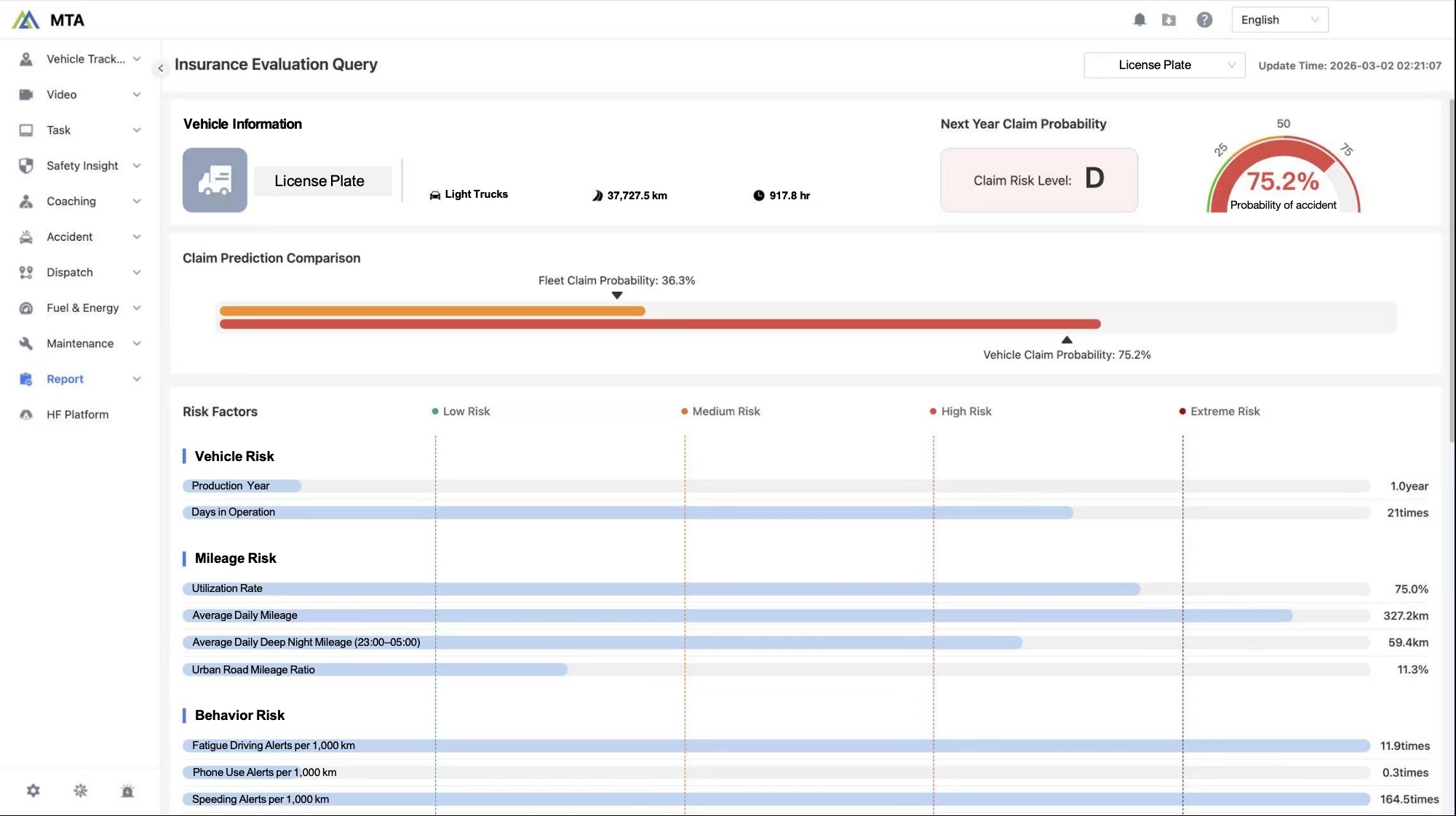
iDriverSafety (Intelligent Driving Safety Control): Utilizing a multi-modal AI risk warning engine, this system performs real-time identification of fatigue and distracted driving across the cloud, end, and edge. It provides millisecond dynamic intervention through voice interaction and builds a comprehensive "digital portrait" of the driver, significantly reducing accident rates by reshaping safety habits.
iRiskRating (Intelligent Underwriting & Risk Rating): Deep learning algorithms build advanced underwriting risk models that deeply mine multi-dimensional feature factors. This allows for dynamic quantitative rating of fleet risk, providing insurers with the decision support needed for accurate, behavior-based pricing and differentiated risk control, reduces insurance fraud by up to 60%.
iCargoSecurity (Intelligent Freight Asset Security): Based on AI video algorithm analysis, this engine identifies abnormal behaviors in real-time, such as fraudulent delivery, unauthorized loading/unloading, or transit risks. It creates an end-to-end intelligent security system to actively intercept risks and protect valuable assets throughout the transportation process.
iAnti-fraud (Intelligent Claims Anti-fraud): Equipped with a large model specifically for claim-related fraud identification, this system utilizes knowledge map mining and multi-dimensional cross-judgment for risk pre-interception. This guards the safety of the entire insurance management link by accurately identifying fake accidents or exaggerated losses, thereby reducing claim leakage.
This data-driven culture allows fleets to reward drivers with high safety scores while increasing internal accountability and targeted training for those with high-risk behaviors.
Quantifiable Operational Impact of AIoT Integration
The following table demonstrates the optimization potential when transitioning from legacy GPS to integrated AIoT risk control. To calculate the specific ROI for your fleet, refer to our analysis on fleet insurance loss mitigation.
Expense Category | Optimization Potential | Key Driver of Savings |
Insurance Claim Cost | 20% - 30% Reduction | Preventive alerts and fraud mitigation |
Accident Frequency | 30% - 50% Reduction | Real-time ADAS/DMS intervention |
Legal & Defense Costs | 40% - 60% Reduction | Video exoneration and rapid settlements |
Fuel & Energy Use | 10% - 16% Savings | Correction of harsh acceleration and idling |
Maintenance (R&M) | 18% - 30% Reduction | Predictive fault code management |
Legal Defense with Tamper-Proof Digital Evidence
In a litigious environment, subjective accident reconstruction models often disadvantage commercial fleets. Streamax provides "Truth in Data" to neutralize aggressive plaintiff tactics like the "Reptile Theory."
When the 6-axis G-sensor detects a harsh impact, the system automatically locks and uploads a secure video file to the cloud. This data includes encrypted GPS coordinates, vehicle speed, and braking force. Under Federal Rule of Evidence 901 (FRE 901), this cryptographically secure chain of custody helps establish the reliability of video evidence for legal proceedings. High-definition video enables defense counsel to provide clarity on driver fault in "swoop and squat" staged accidents — supporting exoneration when appropriate — or settle legitimate claims early to avoid jury-driven financial multipliers. Learn how to utilize these tools in our Guide to Combatting Nuclear Verdicts.
Driving Stability in the Insurance Sector
The integration of AIoT and predictive analytics is essential for the long-term sustainability of the commercial transport industry. This solution moves the industry beyond the limitations of historical proxies—like driver age or past accidents—and into a reality of real-time, behavioral risk management.
By identifying high-risk patterns before they result in a claim, fleets can implement targeted training that permanently reshapes driver habits. For insurers, the availability of granular, transparent data allows for more accurate underwriting and the ability to offer competitive rates to well-managed fleets. Ultimately, Streamax technology serves as a bridge, aligning the financial interests of insurers with the safety objectives of fleet operators to achieve a "Vision Zero" future.
FAQ: Understanding Fleet Risk Solutions
1. How does AI behavior labeling improve driver training?
AI algorithms automatically label events like tailgating, distracted driving, or harsh braking. This enables managers to provide targeted coaching to drivers based on their specific driving patterns,helping each driver improve in areas most relevant to them—while also reinforcing safe behaviors across the entire fleet.
2. Can these systems prevent cargo theft insurance claims?
Yes. Solutions like the Streamax Z5 use AI cameras to monitor cargo volume and trailer door status. Zone-based alerts notify managers if a door is opened in an unauthorized area, providing an electronic audit trail to combat cargo theft and "crash-for-cash" schemes.
3. What is the average timeframe for a return on investment (ROI)?
Most fleets report a full ROI within 12 to 18 months. This is achieved through a combination of reduced accident frequency, lower insurance premiums, and a 10%–25% reduction in fuel costs through better driving habits.