In the continuous cycle of global mining, fatigue is the single most dangerous threat to operational safety. With haul trucks operating 24/7 across rotating shifts, human operators are frequently pushed to their physiological limits, leading to a high risk of "microsleeps"—brief, involuntary lapses into unconsciousness. Industry data reveals that approximately 65% of haul truck accidents in surface mining are directly caused by fatigue, and impaired operators are 14 times more likely to experience a life-threatening microsleep event. To bridge the gap between high-intensity production and human biology, Artificial Intelligence (AI) through Driver Monitoring Systems (DMS) has become the essential frontline defense.
A mining-grade DMS utilizes specialized sensors and edge-based AI to provide a real-time safety envelope. It adapts to the extreme demands of the 24/7 mining cycle through three core technological pillars: seeing in total darkness, analyzing complex human behavior, and surviving the brutal physical environment of the mine site.
1. Night Vision: How the System Sees in Total Darkness
The most immediate challenge for 24/7 operations is the shift from blinding daylight to absolute darkness. Standard cameras fail in these extremes, but DMS technology adapts using Near-Infrared (NIR) illumination, typically at the 940nm wavelength.
Invisible Precision: The 940nm light is completely invisible to the human eye, ensuring that the system can illuminate the cabin and track the driver's pupils in pitch-black conditions in compliance with applicable eye safety standards.
High Dynamic Range (WDR): Mining environments often feature extreme light contrasts—such as a truck exiting a dark tunnel into bright sunlight. Advanced sensors use Wide Dynamic Range (WDR) technology to prevent the image from "washing out," maintaining a clear view of facial landmarks in all lighting scenarios.
2. AI Identification: How the System Judges Driver Fatigue
Fatigue is difficult for an operator to self-diagnose — by the time they feel tired, they may have already experienced several undetected microsleeps. A DMS adapts to this by monitoring objective physiological indicators rather than relying on driver self-reporting.
The Gold Standard: PERCLOS
The primary metric used by AI to identify drowsiness is PERCLOS (Percentage of Eye Closure). Rather than just counting blinks, the system calculates the percentage of time the driver’s eyes are more than 80% closed over a specific interval, such as one minute. If this value exceeds a set safety threshold (typically 20% or 40%), the AI recognizes the onset of a "microsleep" state and triggers an immediate intervention .
Beyond Static Rules: The AI Advantage
While traditional "rule-based" systems rely on fixed mathematical thresholds (such as measuring the exact distance between eyelids), they often lack the flexibility to handle the "long-tail" of unique human variations. AI-driven systems provide a significant advantage by learning from raw data rather than following a rigid checklist.
Diverse Facial Types: Rule-based systems may struggle with operators who have naturally small eyes, often misinterpreting them as being partially closed. Modern AI models are trained on thousands of diverse facial types and environments, allowing them to accurately distinguish between a driver's natural eye shape and actual fatigue.
"Eyes-Open" Fatigue: Some operators can remain in a state of high fatigue or even enter a microsleep while keeping their eyes open. Because AI looks at complex patterns—including subtle gaze fixations and the speed of rapid eye movements—it can detect impairment that would be completely invisible to a simple, rule-based "eye closure" check.
Beyond Eye Tracking:PPE-Optimized Recognition
Because mining operators often wear personal protective equipment (PPE), the AI models must be "mine-optimized." Modern systems are trained to recognize and track faces even when the operator is wearing a hard hat, a respirator, or a safety mask. The system also monitors:
Distraction: Tracking "off-road glances" where the driver’s gaze leaves the primary field of view for too long .
Head Posture: Detecting "nodding" or drooping of the head, which often precedes total eye closure.
Behavioral Risks: Identifying dangerous habits such as mobile phone use or smoking while operating heavy machinery.
3. Rugged Design: Reliable Hardware for Harsh Mine Sites
A mining truck is a "vibrating laboratory" that would destroy standard consumer electronics. To maintain 24/7 reliability, the DMS hardware is engineered to withstand the unique mechanical stresses of the site. Even in extreme environments at altitudes above 5000 meters, Streamax's solution operates stably.
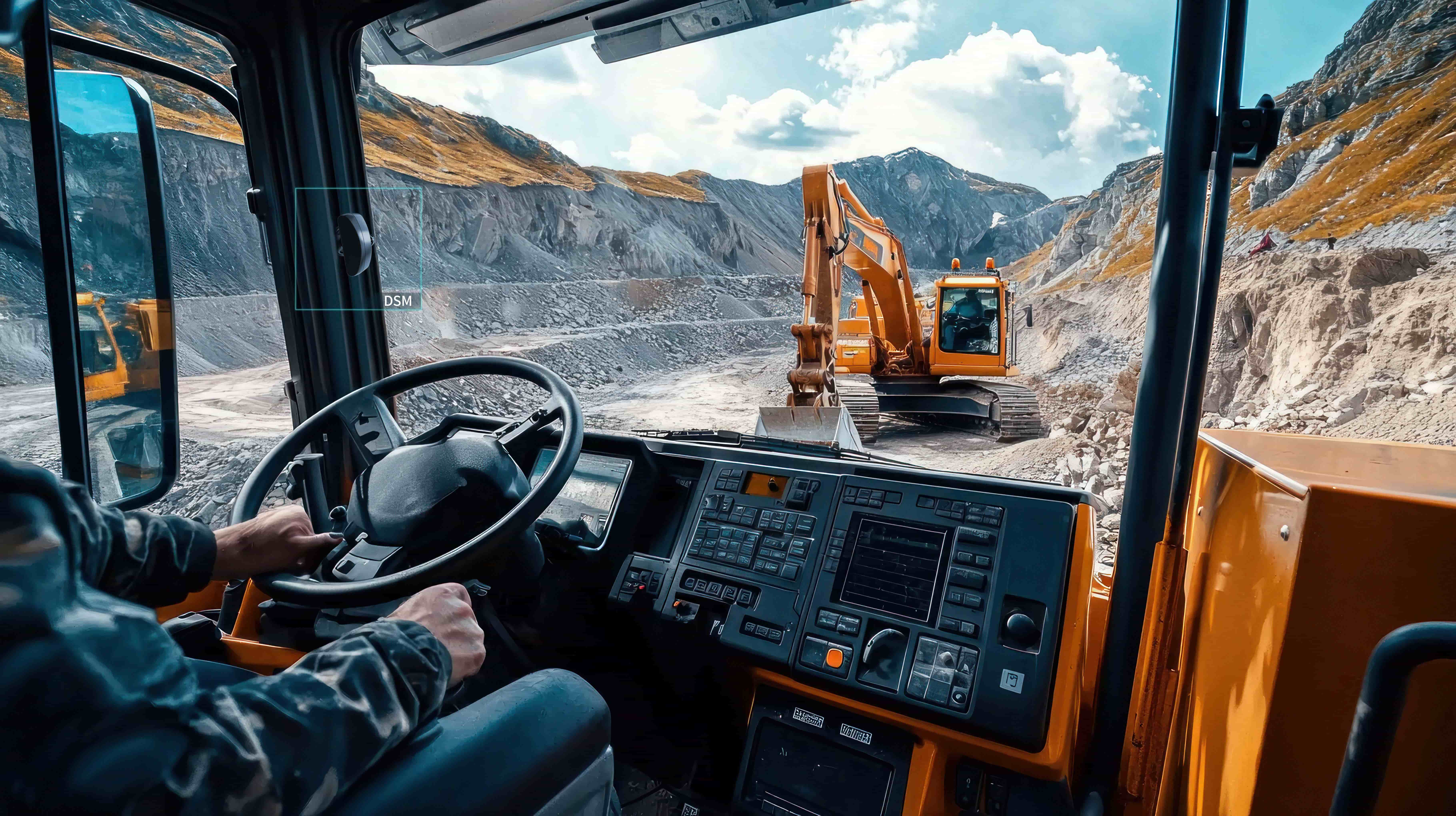
Vibration and Shock Resistance: Mining equipment must adhere to the ISO 16750-3 standard, which involves rigorous testing on "shaker tables" to ensure the internal circuitry and lens alignment do not fail under constant, high-intensity mechanical loads .
Dust and Ingress Protection: Fine mining dust can easily penetrate and overheat electronics. Mining DMS units are typically rated to IP54 or higher, ensuring they are sealed against dust and moisture splashes.
Edge Computing Reliability: In remote mines, network connectivity is often intermittent. A DMS adapts by processing all AI data "at the edge"—meaning the "intelligent brain" (such as the Streamax M10) is located directly on the vehicle. This ensures that even if the truck is in a dead zone, the safety alerts will still function with millisecond-level response times.
4. Smart Alarms: Reducing False Alerts and Driver Stress
A safety system is only effective if drivers trust and respect its warnings. In the repetitive environment of 24/7 shifts, "alert fatigue"—where a driver becomes numb to frequent, low-value alarms—is a serious concern.
Context-Aware Filtering: Advanced AI filters out "nuisance" triggers. For example, the system can be configured to suppress alerts when the vehicle is stationary, idling in a loading zone, or moving at very low speeds. This ensures that when an alarm does sound, the operator knows it is a legitimate and urgent threat.
Tiered Interventions: Warnings are not "one-size-fits-all." A slight increase in fatigue might trigger a gentle audio reminder, while a detected microsleep will trigger a high-intensity combination of loud audio and a vibrating driver’s seat to physically jolt the operator back to alertness .
Data-Driven Safety Culture: The DMS logs every event, allowing fleet managers to create "Driver Scorecards." This data helps identify the highest-risk hours—typically between 3:00 AM and 5:00 AM—allowing for better shift rotation planning and targeted coaching for high-risk operators.
FAQ: Frequently Asked Questions
Q: Will the system alert me every time I blink?
A: No. The AI is trained to distinguish between a normal, healthy blink and a "slow blink" or "eyelid droop" associated with tiredness. Alerts are only triggered when the pattern of eye closure suggests a loss of alertness (High PERCLOS).
Q: Can the camera see my eyes if I’m wearing a mask or a safety helmet?
A: Yes. Professional mining DMS algorithms are specifically optimized to recognize facial expressions even when obscured by personal protective equipment (PPE) like hard hats, respirators, or masks.
Q: What happens if the system detects I am falling asleep?
A: The system will immediately trigger a tiered response. First, a loud audible warning and a visual alert will flash. In high-risk mining environments, the system may also vibrate the driver's seat to ensure they are physically jolted back to alertness.